

Fluorine-Free Oil & Grease Repellent Polymers Market to Reach USD 1,772.0 billion by 2036 Amid Regulatory Shifts
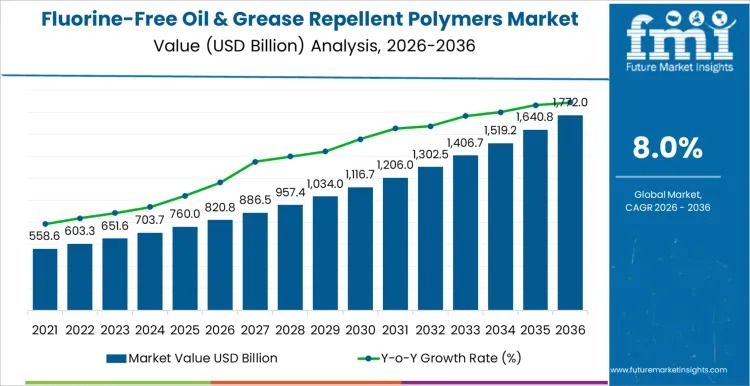
Fluorine-Free Oil & Grease Repellent Polymers Market
Fluorine-Free Oil & Grease Repellent Polymers gain traction as regulations tighten, driving performance-led procurement in packaging, textile, & coating markets
NEWARK, DE, UNITED STATES, January 19, 2026 /EINPresswire.com/ -- The global fluorine-free oil and grease repellent polymers market is poised for substantial expansion, forecasted to grow from USD 820.8 billion in 2026 to USD 1,772.0 billion by 2036, representing a compound annual growth rate (CAGR) of 8.0%. Rising regulatory scrutiny and the push to eliminate PFAS-based chemistries are driving adoption across food packaging, textiles, paper coatings, and consumer products. Procurement decisions increasingly prioritize validated performance, regulatory compliance, and supplier reliability over price, reflecting a shift toward risk-averse purchasing strategies.
Companies sourcing fluorine-free polymers emphasize materials with proven application data, food-contact approvals, and scalability across diverse substrates. Relationships with suppliers are often long-term, given the high switching costs associated with reformulation, line trials, certification updates, and potential disruptions to downstream customers. To mitigate supply risk, buyers are diversifying procurement, favoring suppliers with regional manufacturing presence and transparent regulatory compliance. These disciplined purchasing cycles, combined with substitution-led adoption, are driving steady volume growth across multiple industries.
Explore trends before investing – request a sample report today! https://www.futuremarketinsights.com/reports/sample/rep-gb-31461
Market Overview: Substrate and Application Segmentation
By Substrate:
• Textiles & Nonwovens: 42% market share; used in packaging, hygiene products, and technical fabrics; require oil/grease resistance while maintaining flexibility and softness
• Other substrates: Paper, paperboard, and industrial porous materials
By Application:
• Food contact & packaging: 40% market share; prevents oil/grease migration and preserves structural integrity of packaging
• Other applications: Apparel, technical textiles, industrial, and institutional uses
Key Drivers: Regulatory Pressure and Sustainability
The market’s expansion is largely fueled by environmental and health concerns surrounding PFAS. Companies are actively transitioning to fluorine-free chemistries, such as modified polyesters, polyurethanes, acrylics, and bio-based coatings, which offer functional barrier performance without fluorine. Performance parity remains a central consideration, with formulators optimizing coating weights, multilayer structures, and crosslinking strategies to achieve comparable repellency.
Advances in polymer engineering, including hyperbranched architectures, silicone-based repellents, and biomimetic surface chemistries, are enhancing barrier performance while reducing reliance on high-global-warming-potential carriers. Cross-industry focus on repeatable, scalable finishing processes encourages development of polymers compatible with spray, pad, or coating lines, supporting consistent throughput and manufacturing efficiency.
Regional Dynamics: High-Growth Markets
China leads the market with a projected CAGR of 9.2%, driven by its expansive food packaging, paper, and molded fiber manufacturing base. Rapid replacement of fluorinated treatments in takeaway food packaging, bakery papers, and quick-service restaurant applications is fueling adoption. Manufacturers prioritize polymers offering grease resistance, processability on high-speed coating lines, and cost efficiency for large-scale production.
Brazil follows closely with an 8.8% CAGR, supported by growth in foodservice packaging, paper products, and molded fiber applications. Buyers emphasize cost-performance balance and local coating compatibility, with adoption strongest in fast-food packaging and disposable tableware. Germany, South Korea, and Japan show steady growth, guided by stringent regulatory frameworks, performance validation, and incremental substitution of legacy fluorinated treatments.
• China (CAGR 9.2%): Large food packaging, paper, and molded fiber base; focus on high-volume, cost-efficient polymers with consistent barrier performance
• Brazil (CAGR 8.8%): Driven by foodservice packaging, paper products, and molded fiber; adoption strongest in fast-food packaging and disposable tableware
• Germany (CAGR 7.6%): Strict regulations; buyers prioritize polymers with predictable grease resistance and certified food-contact compliance
• South Korea (CAGR 7.2%): Increasing demand in food packaging, nonwovens, and specialty paper; focus on uniform coating and barrier performance
• Japan (CAGR 6.5%): Emphasis on material reliability, low migration, and controlled performance in high-quality food packaging
Competitive Landscape: Performance and Compliance Lead
Market competition is driven by functional performance, environmental compliance, and integration into textile and surface treatment processes. Suppliers differentiate through polymer design that balances repellency, durability, washability, and process compatibility.
Archroma (formerly Huntsman Textile Effects) anchors the market with fluorine-free repellents for fabrics, nonwovens, and performance wear. Rudolf Group offers bio-based polymer systems emphasizing low environmental impact and reliable oil/grease resistance. HeiQ, Pulcra Chemicals, and DyStar provide multi-functional finishes and tailored polymer architectures, while BASF SE, Daikin, and Solvay leverage R&D scale to support validated, high-performance solutions. Across suppliers, competitive advantage is defined by consistent repellency, environmental credentials, and seamless finishing process integration rather than pricing.
Key Players in Fluorine-Free Oil & Grease Repellent Polymers Market
• Archroma
• Huntsman Textile Effects (now Archroma)
• Rudolf Group
• HeiQ
• Pulcra Chemicals
• DyStar
• CHT Group
• BASF SE
• Daikin (fluorine-free ranges)
• Solvay (barrier chemistries)
Market Outlook
The fluorine-free oil and grease repellent polymers market represents a compliance-driven, high-growth segment within advanced functional materials. Increasing regulatory bans on PFAS, expanding food packaging and textile applications, and a focus on performance reliability will continue to propel market adoption. Buyers and formulators are expected to maintain disciplined procurement strategies while seeking suppliers capable of delivering validated, scalable, and environmentally compliant polymer solutions.
Browse Related Insights
Fluorine-Free Oil and Grease Repellents Market: https://www.futuremarketinsights.com/reports/fluorine-free-oil-and-grease-repellents-market
Apparel Soil-Release Polymers Market: https://www.futuremarketinsights.com/reports/apparel-soil-release-polymers-market
Erosion Control Polymers and Soil Binders Market: https://www.futuremarketinsights.com/reports/erosion-control-polymers-and-soil-binders-market
Sudip Saha
Future Market Insights Inc.
+18455795705 ext.
email us here
Legal Disclaimer:
EIN Presswire provides this news content "as is" without warranty of any kind. We do not accept any responsibility or liability for the accuracy, content, images, videos, licenses, completeness, legality, or reliability of the information contained in this article. If you have any complaints or copyright issues related to this article, kindly contact the author above.
