

AndaSeat Xtreme Series Wins Silver at 2026 Rome Design Awards for Integrated Standing Desk Design
Xtreme Desk Rome Award AndaSeat
Xtreme Desk Media Comment AndaSeat
Xtreme Desk Series AndaSeat
AndaSeat Xtreme Series Wins Silver at 2026 Rome Design Awards for Integrated Standing Desk Design
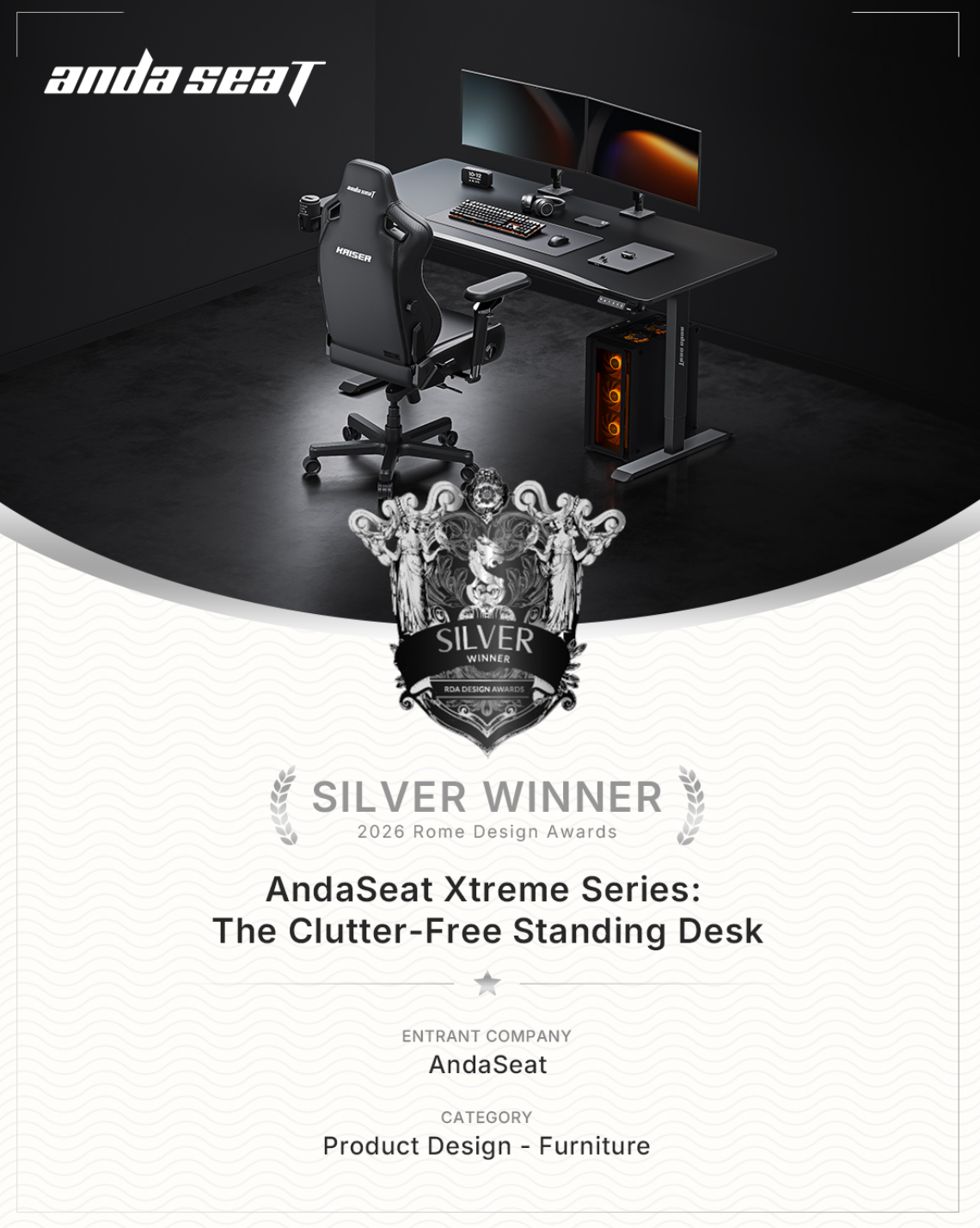
SPOKANE, WA, UNITED STATES, September 15, 2026 /EINPresswire.com/ -- AndaSeat has received a Silver award at the 2026 Rome Design Awards for the Xtreme Series standing desk in the Product Design – Furniture category, recognizing a product developed around a broader idea of what a modern computer desk is expected to manage.The official Rome Design Awards winner listing identifies the entry as “AndaSeat Xtreme Series: The Clutter-Free Standing Desk.” The award description highlights the product’s cold-formed steel T-frame with dual support beams and a design that routes insulated 16AWG/3C power cabling through the desk’s left leg rather than treating electrical routing as an external accessory added after the furniture is assembled.
The recognition arrives as workplace planning increasingly brings furniture, computing equipment, mobility and power infrastructure into the same design conversation.
Updated 2026 guidance from the U.S. General Services Administration recommends adjustable-height work surfaces, adjustable computer components and workplace equipment that supports mobile work. The same guidance addresses power management for computers, monitors and other plug-in devices as part of workplace planning rather than as a completely separate facilities issue.
GSA also notes that computers, monitors and other plug loads can represent a significant portion of office electricity demand. That guidance concerns building energy management and does not evaluate Xtreme or suggest that the desk reduces electricity consumption. It does, however, illustrate how much technology and electrical infrastructure now converges at the modern workstation.
For AndaSeat, that convergence became one of the central design problems behind Xtreme: the desk could no longer be treated simply as a horizontal surface placed above a frame.
From Furniture Surface to Workstation Infrastructure
A conventional desk performs a relatively simple structural task: it supports the objects placed on top of it.
A contemporary computer workstation has a more complicated relationship with those objects.
A monitor needs power and a display connection. A laptop may require a charger, dock and peripheral cables. Gaming and creator systems can add speakers, lighting, audio interfaces, controllers and other equipment. A height-adjustable desk introduces another variable because the complete surface moves while those connections remain attached.
The question therefore changes from “Where can the cables be hidden?” to “How should power and movement be designed into the furniture architecture?”
Xtreme addresses that question through what AndaSeat describes as its integrated power-leg structure.
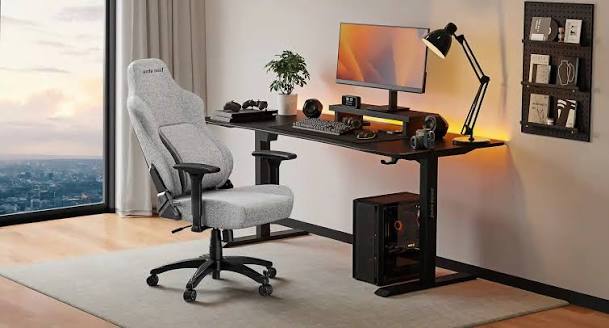
Instead of allowing the desk’s own primary cabling to hang externally along the frame, insulated wiring runs through the left leg, with power access integrated into the structure. A separate steel tray beneath the desktop provides a defined area for power strips and excess equipment cabling.
The Rome Design Awards entry specifically identified this approach as a central part of the Xtreme design concept.
The distinction is important. Cable management is often treated as an accessory feature — clips, ties or trays applied after a desk is complete. Xtreme treats part of the cable path as architecture.
The leg is therefore performing two functions at once: carrying structural load and providing a route for electrical infrastructure.
Movement Changes the Structural Requirements of a Desk
Integrating infrastructure into a standing desk creates an additional challenge: the furniture is not static.
Xtreme adjusts across a height range of approximately 28.7 to 46.1 inches, or 730 to 1,170 mm. Its electric system moves at 22 mm per second, with a company-rated operating noise level below 50 dB. The desk supports loads up to 70 kg, including the desktop and installed equipment.
When a desk moves, stability becomes part of the user interaction rather than a specification that matters only during assembly.
A monitor, keyboard and mouse remain on the surface while the frame changes height. If the supporting structure becomes substantially less stable as it extends, the relationship between the user and equipment also changes.
Xtreme uses a cold-formed steel T-frame with dual support beams, long side brackets, two-stage legs and widened feet. The Rome Design Awards description specifically highlighted the dual-beam steel structure as part of the design behind the entry.
The structural idea is therefore connected directly to the movement concept.
The motor creates vertical change. The frame is responsible for maintaining the working platform through that change.
This is why AndaSeat treats the T-frame and electrical system as related components rather than independent specifications. Both are required for a workstation that is expected to move while carrying powered equipment.
Control Design Turns Movement Into a Repeatable State
A moving desk also needs a way to define where that movement should stop.
Xtreme incorporates a digital control panel with three memory presets, allowing selected working heights to be stored and recalled. The panel also includes a real-time height display, an adjustable sedentary reminder, anti-collision functionality and a child-lock control.
These features change the role of the motorized mechanism from simple vertical movement to repeatable positioning.
A user does not need to estimate the same desk height each time the work surface moves. The stored settings create defined states within the desk’s available range.
The anti-collision system addresses another consequence of movement. It is designed to stop and reverse the desk when resistance is detected during vertical travel. The function does not remove the need to keep the desk’s movement path clear, but it adds a control layer around a piece of furniture that contains an active motor.
In this design model, movement, sensing and positioning are parts of furniture interaction rather than features borrowed from unrelated electronics.
The Award Recognizes a System Rather Than One Isolated Feature
The 2026 Rome Design Awards recognizes work across architecture, interiors, furniture, lighting, product design and other design disciplines. The official winner gallery lists the Xtreme Series as a Silver winner in Product Design – Furniture.
For AndaSeat, the significance of the recognition is not limited to one mechanism.
The award entry combines several design decisions: a reinforced structural frame, integrated power routing, under-desk cable storage, powered height adjustment, memory controls, anti-collision functionality and a desktop intended to work across professional and gaming environments.
What connects those elements is a system-based approach.
The frame is not designed separately from the motor. The motor is not designed separately from the cable path. The cable path is not designed separately from the equipment placed on the desktop.
Each feature responds to another part of the workstation.
That philosophy also reflects a broader direction visible in current workplace guidance. GSA's 2026 furniture and equipment guidance places height-adjustable furniture, adjustable computer equipment, mobile technology and plug-load management within the same workplace-planning framework.
Xtreme translates a similar systems question into a consumer product: how can one desk coordinate the physical requirements of equipment, power and movement without requiring each problem to be solved independently after purchase?
Xtreme Extends AndaSeat From Seating Into Workspace Architecture
AndaSeat began developing ergonomic seating products before expanding into desks and other workstation components.
The Xtreme Series represents a broader change in that product-development scope.
A chair primarily manages the relationship between the body and seated support. A desk must coordinate a different set of relationships: working height, equipment weight, desktop space, power routing, structural movement and the clearance around the user.
The Rome Design Awards recognition gives that transition a design milestone.
Rather than approaching Xtreme as an enlarged accessory to the company’s chairs, AndaSeat developed the desk around problems specific to powered work surfaces — particularly stability through vertical movement and the physical integration of electrical connections.
The resulting product reflects the principle behind its award entry: workstation furniture increasingly acts as infrastructure.
Its value is not determined solely by the surface visible from above. The leg architecture, frame geometry, power path, cable storage and control system all contribute to how the desk functions once computers and other equipment are added.
For AndaSeat, the 2026 Rome Design Awards Silver recognition reinforces that design direction: furniture can remain visually simple while becoming mechanically and functionally more integrated underneath.
About AndaSeat
Founded in 2007, AndaSeat develops ergonomic furniture and workspace products for gaming, professional and home environments. Its portfolio includes ergonomic chairs, standing desks, monitor arms and related workspace accessories. The company’s product-development approach combines structural engineering, adjustable ergonomics, material development and increasingly integrated workstation systems designed around how people interact with both furniture and technology.
AndaSeat Marketing
AndaSeat
email us here
Visit us on social media:
LinkedIn
Instagram
Facebook
YouTube
TikTok
X
Legal Disclaimer:
EIN Presswire provides this news content "as is" without warranty of any kind. We do not accept any responsibility or liability for the accuracy, content, images, videos, licenses, completeness, legality, or reliability of the information contained in this article. If you have any complaints or copyright issues related to this article, kindly contact the author above.
